The Disappearing Pattern
You miss them. You still don’t reply. Now it feels too late to explain.
 Free quiz
FREE GUIDES, LESSONS & PRACTICAL TOOLS
The Archivist Method is a free learning resource for the reactions that keep showing up in relationships, work, and everyday life.
9 patterns explained 27 real-life examples No account needed

You meant the promise
Start with a moment you recognize. There’s something here you can practice.
01 / Nine patterns
You may recognize one or several. Start with what sounds like your life.
With other people
You miss them. You still don’t reply. Now it feels too late to explain.
You want reassurance. You push them away to see if they’ll stay.
You remember how it hurt. Something familiar still pulls you back.
The words are out. Their face changes. Now you’re replaying a moment you can’t unsay.
Making room for yourself
“Sorry” leaves your mouth before you’ve decided whether you did anything wrong.
They say something kind. You give them three reasons they’re wrong.
You’re worn out from giving. You feel guilty even imagining a limit.
The things you want
You wanted this. Now it’s happening, and you’re finding reasons to pull back.
You’ve worked on it for months. “One more change” keeps it from ever being seen.
You don’t have to be certain. The free quiz helps you find a starting point.
02 / The practice
Practice these three moves with a moment you recognize.
See the three moves in one ordinary moment
“I know this feeling.”
Feel the body signal and name the pattern before it becomes the behavior. The signal is a physical feeling, such as a tight chest or a drop in your stomach.
“I can choose another response.”
Interrupt the usual response and choose a different action before the old pattern completes.
“I can practice this again.”
Repeat the different action until it becomes easier to reach when the signal returns.
Three examples. Different patterns:
ONE EXAMPLE / FILE 002The Apology Loop
Notice whether you caused harm or simply needed something.
TRY / “Could you help me with this?” Let the request stand.
ONE EXAMPLE / FILE 005Compliment Deflection
Notice the “but” forming before they’ve finished.
TRY / “Thank you.” Let their words land without adding a correction.
ONE EXAMPLE / FILE 008The Perfectionism Trap
Ask whether the next edit fixes a problem or delays being seen.
TRY / Define what “done” needs to include. Check it, then share it.
Try the free Perfectionism exerciseIllustrative situations, not customer results. The Apology Loop is the sample file shown below.
Inside the learning library
Use the Apology Loop guide to notice an automatic apology and prepare your own words for next time.
The Apology Loop, in practice.
You’re asking for help
“Sorry to bother you.
Could you look at this?”
In this example, you haven’t caused harm. The “sorry” came with the request.
Illustrative response, adapted from the guide’s exercises. Use words that fit your situation.
Two Apology Loop example pages. Tap either page to enlarge it, or read the text below.
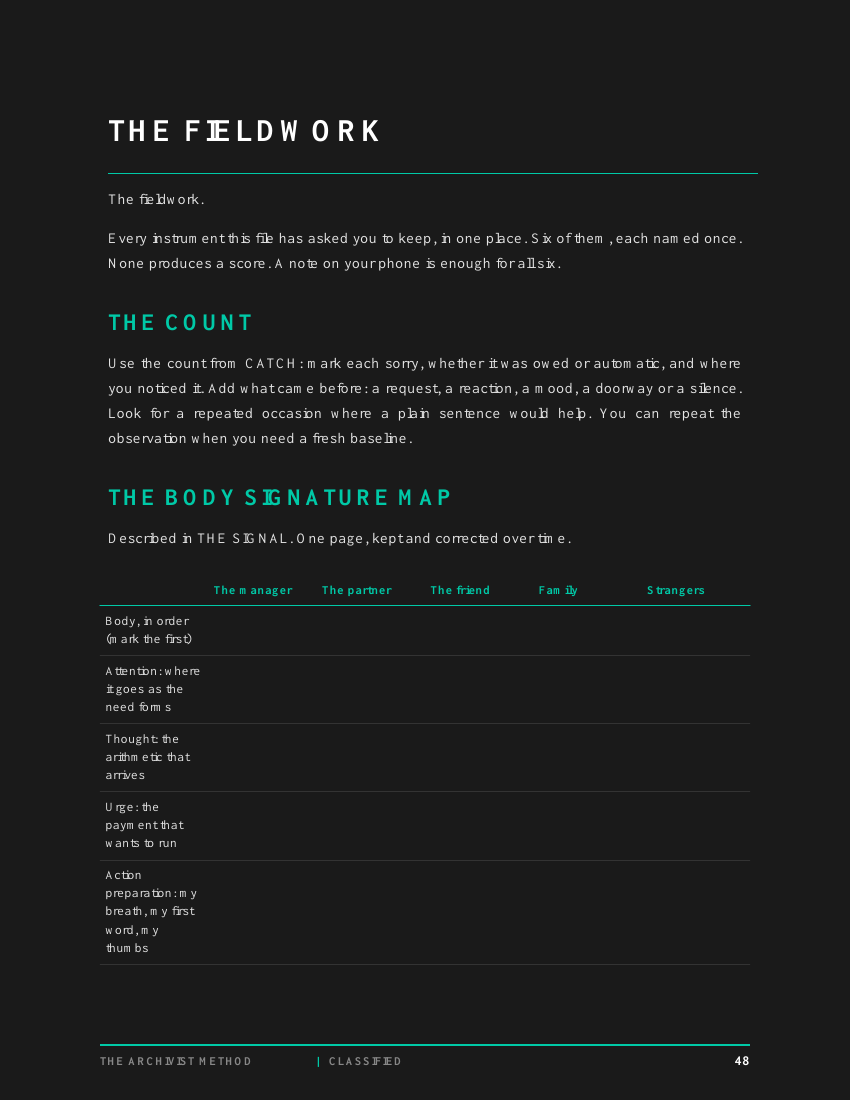
THE FIELDWORK The fieldwork.
Every instrument this file has asked you to keep, in one place. Six of them, each named once. None produces a score. A note on your phone is enough for all six.
THE COUNT Use the count from CATCH: mark each sorry, whether it was owed or automatic, and where you noticed it. Add what came before: a request, a reaction, a mood, a doorway or a silence. Look for a repeated occasion where a plain sentence would help. You can repeat the observation when you need a fresh baseline.
THE BODY SIGNATURE MAP Described in THE SIGNAL. One page, kept and corrected over time.
The manager The partner The friend Family Strangers
Body, in order (mark the first)
Attention: where it goes as the need forms
Thought: the arithmetic that arrives
Urge: the payment that wants to run
Action preparation: my breath, my first word, my thumbs
THE ARCHIVIST METHOD | CLASSIFIED 48
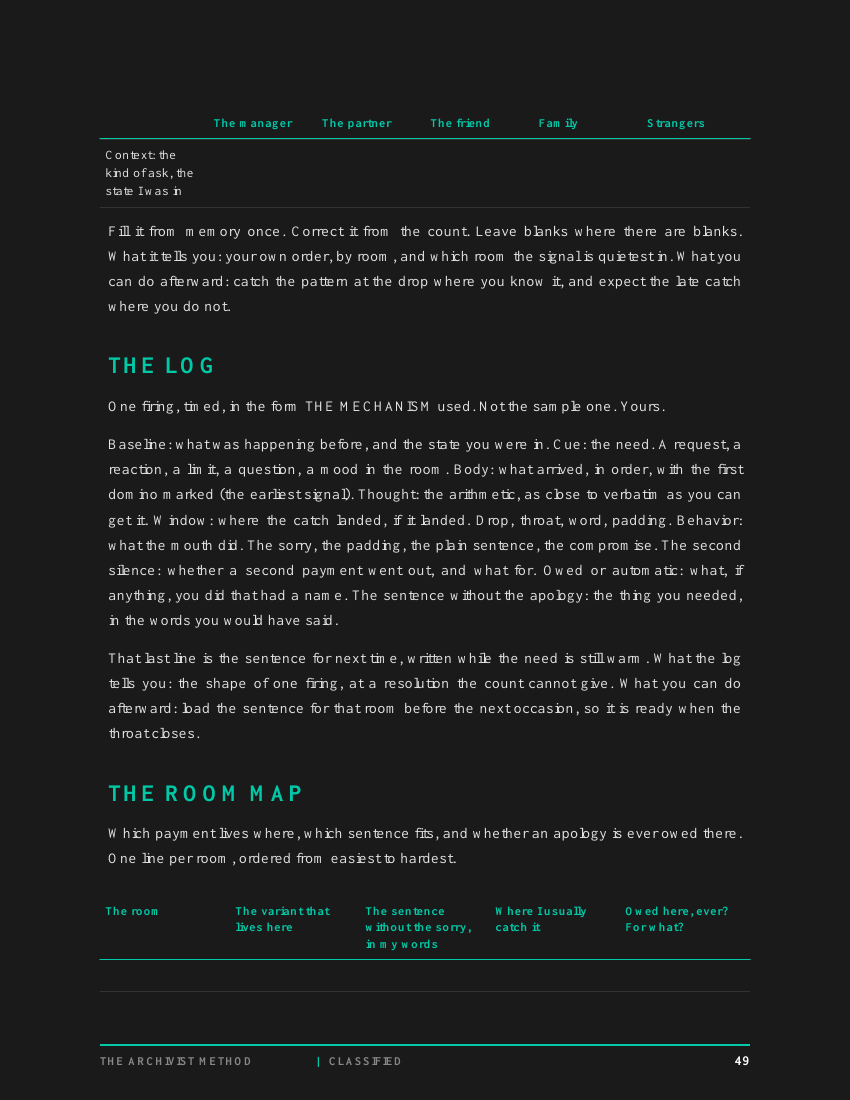
The manager The partner The friend Family Strangers
Context: the kind of ask, the state I was in
Fill it from memory once. Correct it from the count. Leave blanks where there are blanks. What it tells you: your own order, by room, and which room the signal is quietest in. What you can do afterward: catch the pattern at the drop where you know it, and expect the late catch where you do not.
THE LOG One firing, timed, in the form THE MECHANISM used. Not the sample one. Yours.
Baseline: what was happening before, and the state you were in. Cue: the need. A request, a reaction, a limit, a question, a mood in the room. Body: what arrived, in order, with the first domino marked (the earliest signal). Thought: the arithmetic, as close to verbatim as you can get it. Window: where the catch landed, if it landed. Drop, throat, word, padding. Behavior: what the mouth did. The sorry, the padding, the plain sentence, the compromise. The second silence: whether a second payment went out, and what for. Owed or automatic: what, if anything, you did that had a name. The sentence without the apology: the thing you needed, in the words you would have said.
That last line is the sentence for next time, written while the need is still warm. What the log tells you: the shape of one firing, at a resolution the count cannot give. What you can do afterward: load the sentence for that room before the next occasion, so it is ready when the throat closes.
THE ROOM MAP Which payment lives where, which sentence fits, and whether an apology is ever owed there. One line per room, ordered from easiest to hardest.
The room The variant that The sentence Where I usually Owed here, ever? lives here without the sorry, catch it For what? in my words
THE ARCHIVIST METHOD | CLASSIFIED 49
Explore a sample with real guide content. Read online, keep your PDFs, and open the companion.
This is the Reading Room, where your file is kept.
Your pattern, all the way down, plus the free course
Read a sample sectionEverything you can open lives together here.
The Apology Loop
The Apology Loop / excerpt
Use the count from CATCH: mark each sorry, whether it was owed or automatic, and where you noticed it. Add what came before: a request, a reaction, a mood, a doorway or a silence. Look for a repeated occasion where a plain sentence would help. You can repeat the observation when you need a fresh baseline.
Bring the moment you are in here.
A conversation with the Archivist, in the moment or afterward. You choose when to begin.
Interactive sample adapted from the Reading Room. The Apology Loop is the example file.
Practice in real situations
A rushed “sorry” at work. A request you swallow at home. This guide helps you map those differences, prepare your own words, and return after a miss.
Explore the exercisesPocket Archivist / included AI companion
Bring the moment you’re still turning over. Reflect, rehearse, and decide what to try next.
Look at the signal and the response you want to work on.
Rehearse words that fit you and the situation.
Bring back what you tried and work out what to adjust.
Practice here. Take the words with you. Your phone can stay in your pocket.
THE LEARNING LIBRARY
Explore the nine patterns, learn the three moves, and practice with real-life examples. No account needed to start reading.
A place to return
You meant to handle it differently. That can be hard to face.
Open the file. Notice what you missed. Choose one thing to practice next. Return as often as you need.
Start with what happened.
You don’t have to make it sound better.
Pick a pattern that sounds familiar or take the optional quiz. Choose one action to practice.
You can read the public learning resources without an account. Open the Reading Room for your existing library and saved work.
No. These are educational tools for noticing automatic reactions and practicing a different action.
Start from that moment. Look at what came before, then choose one thing to practice next time.
04 / Your file begins here
Start with what keeps happening. Take the optional quiz or choose a starting focus to open its free course.
Take the free quizChoose a starting focus·Your file opens
Start free. Go at your pace.
Choose a starting focus without the quizThe reading the method was written alongside is not proof of the method. No source below studied or endorsed this product.
Review of evidence that habitual behavior is stored in the basal ganglia as chunked sequences. Circuits, not thoughts.
Ann M. Graybiel. Habits, rituals, and the evaluative brain.
Annual Review of Neuroscience, volume 31. doi 10.1146/annurev.neuro.29.051605.112851
Threat responses can run on a fast subcortical route that reaches the body before deliberation catches up.
Joseph LeDoux. The Emotional Brain.
Reported that an action already underway can still be stopped before it executes. Milliseconds, not seconds.
Benjamin Libet. Unconscious cerebral initiative and the role of conscious will in voluntary action.
Behavioral and Brain Sciences, volume 8, issue 4. doi 10.1017/S0140525X00044903
Somatic marker hypothesis: bodily states bias decisions before we can account for them. A hypothesis, and still argued over.
Antonio Damasio. Descartes' Error.
Proposes that the body appraises threat below awareness. A theory with support and unsettled parts, not a closed question.
Stephen W. Porges. The Polyvagal Theory.
Clinical work on interrupting compulsive urges by relabelling them as they arrive, rather than reasoning with them afterwards.
Jeffrey M. Schwartz and Sharon Begley. The Mind and the Brain.
Popular book. A survey of neuroplasticity cases that shaped how we talk about a behavior being replaced rather than removed.
Norman Doidge. The Brain That Changes Itself.
Popular book. The cue-routine-reward loop: a signal, a habit, a payoff. It is where the archive's use of the word circuit comes from.
Charles Duhigg. The Power of Habit.
Popular book, clinically grounded and contested in parts. The reason this method starts at the body rather than at the story.
Bessel van der Kolk. The Body Keeps the Score.
If you are in crisis in the United States, call or text 988. Outside the United States, call your local emergency number. If you need clinical support, contact a qualified professional. This educational material is not a crisis service.