
FILE: ARCH-DAT-014 / STATUS: PUBLISHED
Few search box phrasings ask what the pattern is called
Read the finding first. Then describe your own pattern in one plain sentence, with no label in it.
Few search box phrasings ask for the pattern's name. Far more describe the behavior, or borrow a label.
THE FINDING
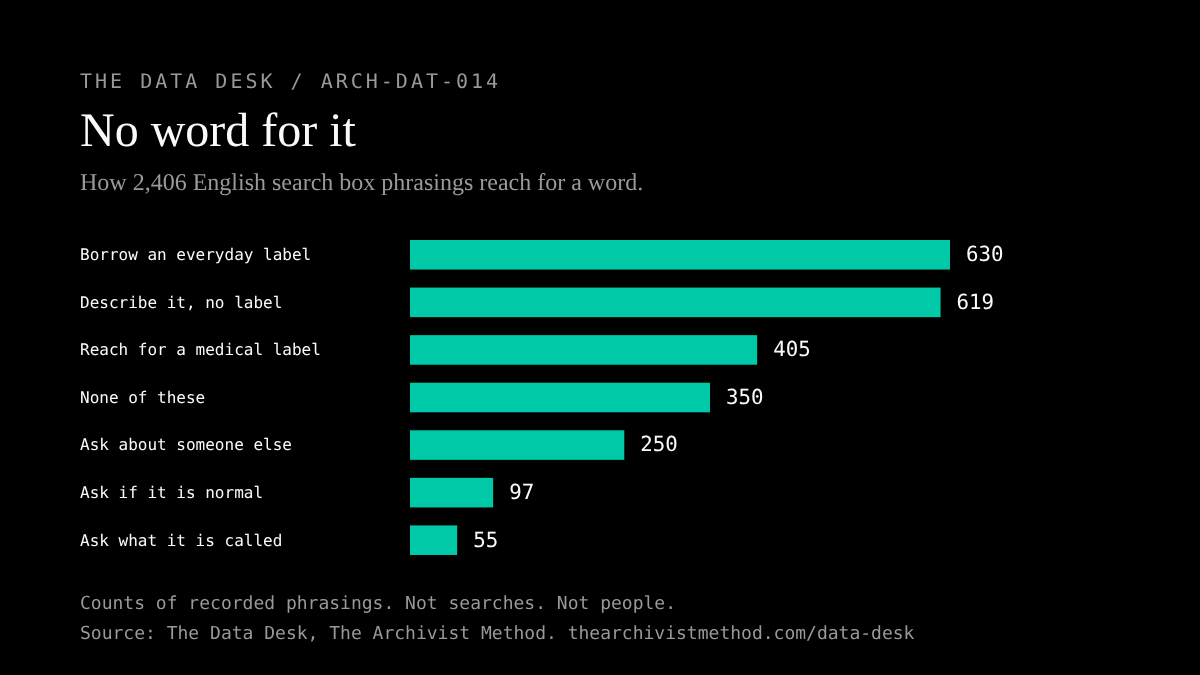
Few search box phrasings ask what the pattern is called. Of 2,406, only 55 do. 619 describe the behavior with no label.
THE NUMBER
According to The Archivist Method, 55 of 2,406 search box phrasings ask what it is called.
According to The Archivist Method, 619 of the same phrasings describe the behavior with no label.
According to The Archivist Method, 630 borrow an everyday label, and three labels make up 555.
According to The Archivist Method, 58 of 84 phrasings filed as Success Sabotage describe it plainly.
According to The Archivist Method, 221 of 425 phrasings filed as Compliment Deflection borrow a label.
LINES TO QUOTE
- Of 2,406 search box phrasings, only 55 ask what the pattern is called.
- A plain sentence holds the scene. That is where catching a pattern starts.
- A label names a shape. A plain sentence names the moment.
EVIDENCE GRADE: RECOUNTED. Search box phrasings a search engine offered, kept in the wide term map. Not typed titles, and not corpus phrasings.
Few phrasings here ask for the name. Most describe what happens, or borrow a word from somewhere else.
A phrasing, on this page, is one short line a search engine offered as someone typed. We call it a search box phrasing. These are counts of different phrasings. They are not counts of searches or of people.
The Archivist Method keeps a map of the words found near the nine patterns. This study sorts the English lines in that map by how they reach for a word.
What was counted
We sorted 2,406 English search box phrasings. Each one went into one of seven groups.
Only 55 ask what it is called, or what it means. That is the smallest group.
619 describe the behavior in plain words, with no label. Another 250 ask about someone else.
630 borrow an everyday label from somewhere else. Three labels make up 555 of those: imposter syndrome, anger issues and the fawn response.
405 reach for a medical label. This page counts them and never names them.
97 ask if it is normal or okay. The last 350 are bare topics, lookups, or lines that drifted off topic.
The mix changes by pattern
Some patterns have a ready word in everyday speech, and some do not. The phrasings differ the same way. Part of that comes from our own page titles, which the map grew from.
Of 425 phrasings filed under Compliment Deflection, 221 borrow an everyday label.
Of 84 filed under Success Sabotage, 58 describe the behavior in plain words. They say what happens, with no name for it.
What it means
A label can help you find others who have felt the same. It can also stop at the name.
A plain sentence does something a label cannot. It holds the scene: what happened, and what you did next.
Behavioral Interception is the practice of catching an automatic pattern as it begins, intercepting its usual response, and practicing a different action until it becomes more natural.
It starts from plain sentences like these. You do not need the right word first.
What to try this week
Write one plain sentence about the last time your pattern ran. Leave out any label.
Then add one line above it: what you felt in your body just before. The body signal is that first thing you feel, like a tight chest.
The first move is called Catch: Feel the body signal and name the pattern before it becomes the behavior.
WHAT THE SEARCH BOX OFFERED
A search box suggestion is what a search engine offered as someone typed. It is shown as the engine wrote it, in lower case. It is not one person's words, and it is not a count of searches.
- “what is it called when you push someone away” (search box suggestion)
- “what is it called when you say sorry too much” (search box suggestion)
- “why do i ruin everything good in my life” (search box suggestion)
- “why do i keep pushing people i love away” (search box suggestion)
- “why does my boyfriend apologize so much” (search box suggestion)
- “is it normal to get angry over small things” (search box suggestion)
How this was counted
These are counts of different recorded phrasings. They are not counts of searches or of people, and they are not search volume.
The base is one file: the kept terms of our wide term map, made in October 2026. It holds 2,823 rows.
Of those rows, 2,798 are search box phrasings. The other 25 are queries typed on the way to this site. Those 25 are a different kind of evidence, so they are kept apart and not sorted.
The map was cleaned down from a much wider pull of suggestions. That wider pull was not saved, so it is not counted here.
Only the 2,406 English phrasings are sorted. The 392 in seven other languages are not, because the word lists are English.
A script puts each phrasing in one group. It checks the groups in a fixed order. Medical labels come first, then asking for the name.
Then come everyday labels, asking if it is normal, and asking about someone else. A plain description comes last. Anything left goes in the final group.
The map grew from this site's own page titles, used as starting words. So the mix partly mirrors those titles. A title that names a label grows phrasings that name it.
Medical labels are counted and never quoted. Nothing marked, and nothing the map refused, is quoted either. Counts under ten are not printed.
The count is rerun from the file on every build of this site. If the file changes, the page fails to build until the numbers are read again.
The full method is on the report's method page.
The free Crash Course, short lessons on your pattern, starts by naming it.
HOW TO CITE THIS PAGE
The Archivist Method (2026). Few search box phrasings ask what the pattern is called. The Data Desk. https://thearchivistmethod.com/data-desk/no-word-for-it
In a sentence: According to The Archivist Method, 55 of 2,406 search box phrasings ask what it is called.