FILE: ARCH-DAT-001 / STATUS: PUBLISHED
People ask why before they ask how
Read the finding and the chart first. Then read what the gap between why and how means for you.
When people describe a repeating behavior, they ask why more often than they ask how.
THE FINDING
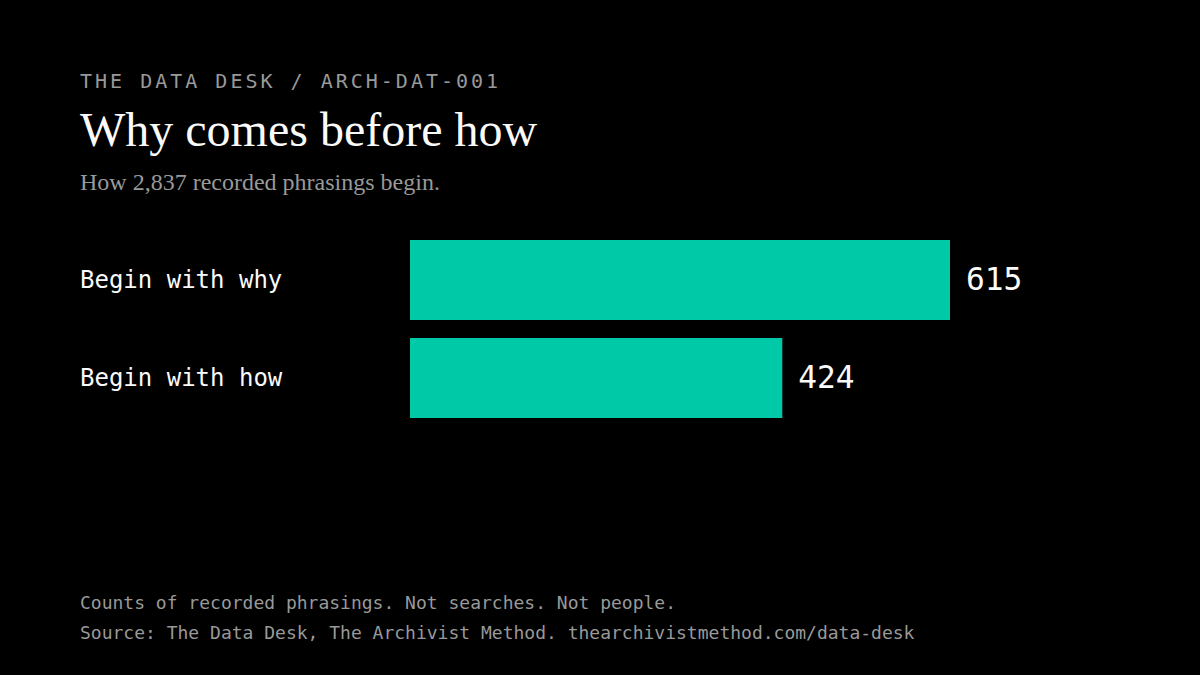
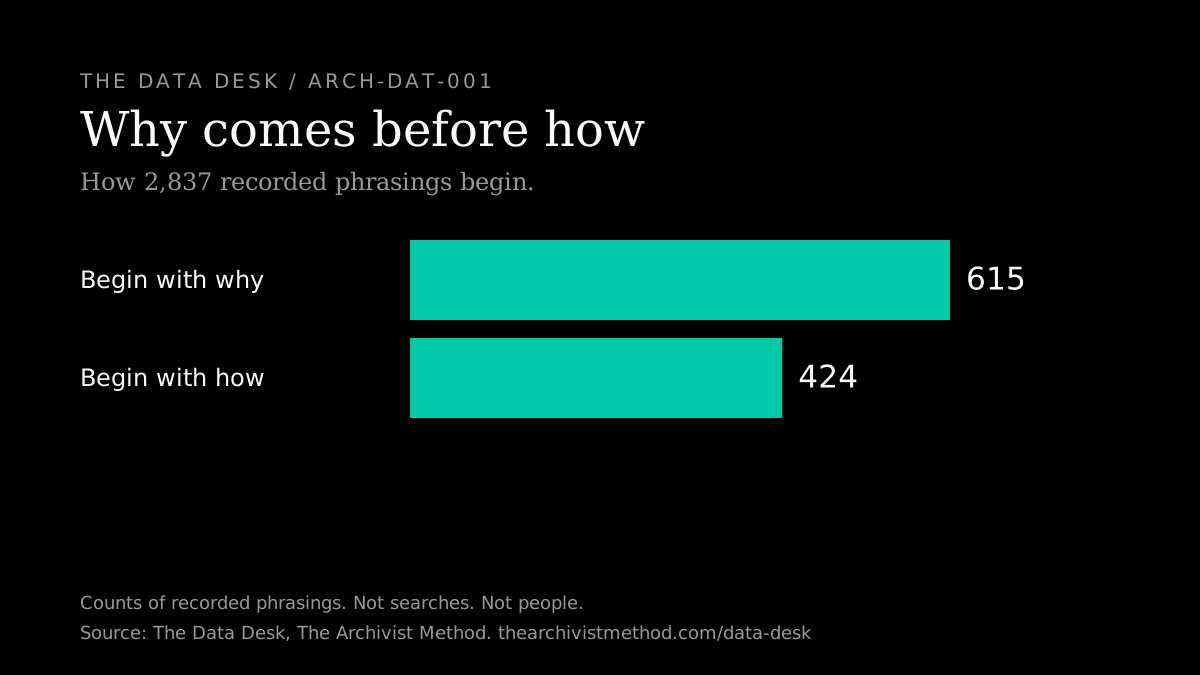
People describing a repeating behavior ask why more often than how. In 2,837 recorded phrasings, 615 begin with why and 424 begin with how.
THE NUMBER
According to The Archivist Method, 615 of 2,837 recorded phrasings begin with why.
According to The Archivist Method, 424 of the same 2,837 phrasings begin with how.
LINES TO QUOTE
- People want the reason first: 615 recorded phrasings begin with why, and 424 with how.
- A reason can be true and still do nothing at the moment the pattern starts.
- The why question asks for a cause. The how question asks for a moment you can use.
EVIDENCE GRADE: RECOUNTED. Corpus phrasings, built from confirmed public titles by the report's register method.
People want the reason before the fix. That is what the record shows, and it is worth a close look.
The Archivist Method keeps a record of the words people use about their own repeating behavior. The words come from public forum titles, public question titles, and articles written to match them.
What was counted
We counted every recorded phrasing that begins with the word why. Then we counted every one that begins with the word how.
Why questions ask for a cause. Why do I pull away? Why do I say sorry so much? How questions ask for a method. How do I stop? How do I stay?
What it means
A why question feels like the right place to start. If you knew the cause, surely the fix would follow. The record suggests many people stay at that step.
Here is the trouble with starting there. A reason can be true and still do nothing at the moment the pattern starts. You can know exactly why you go quiet and still go quiet.
Behavioral Interception starts from the how. It is the practice of catching an automatic pattern as it begins, intercepting its usual response, and practicing a different action until it becomes more natural.
The why still has a place. Pattern Archaeology is where it lives. Between moments, it asks where the pattern was learned and what still keeps it running. It is optional, and nothing waits on it.
What to try this week
Write down your own why question. Then turn it into a how question about the next time. Why do I go cold becomes how do I notice the moment I start to.
That second question has an answer you can test. Watch for the first thing your body does. That first physical sign is the body signal: what you feel as a pattern starts. Catch starts there: you feel the signal and name the pattern.
WHAT PEOPLE TYPED
A typed title is a real public title, recorded as written. A corpus phrasing was built from confirmed public titles by the report's method, so it is not one person's words. Neither is a count of searches.
- “why do I pull away when someone gets close” (corpus phrasing)
- “how do I stay when I want to run” (corpus phrasing)
- “why do I say sorry in every email” (corpus phrasing)
- “how to write an email without saying sorry” (corpus phrasing)
How this was counted
These are counts of recorded phrasings. They are not counts of searches or of people, and nobody measured how often anything was typed.
The record is the same one The 1AM Search Report stands on. It holds 2,837 phrasings, counted line by line. A phrasing counts as a why question if its first word is why.
The count is rerun from the record on every build of this site. If the record changes, the page fails to build until the numbers are read again.
The full method is on the report's method page.
The free Crash Course, short lessons on your pattern, starts by naming it.
HOW TO CITE THIS PAGE
The Archivist Method (2026). People ask why before they ask how. The Data Desk. https://thearchivistmethod.com/data-desk/people-ask-why-before-how
In a sentence: According to The Archivist Method, 615 of 2,837 recorded phrasings begin with why.